IRA Biotech
From strain library to finished pack.
Every formulation moves through the same ten-stage fermentation-to-packaging system — precision-monitored, freeze-dried for shelf life, and tested at each of three facilities.
Ten stages, start to finish.
The same sequence runs at every facility, from a vial held at −80°C to a sealed, shelf-stable pack.
- −80°Cvials held for genetic stability
- 50–100×concentration, about 75% of the water removed
- 2–4%water left in the dry cake
- 1 billionbacteria in a gram of powder
- 1 Seed culture Stages 1–3
- 2 Fermentation Stage 4
- 3 Concentrate & preserve Stages 5–7
- 4 Finish & pack Stages 8–10

Seed culture
-
Stage 01 of 10
Strain library compilation
Proprietary strains held as vials at −80°C to preserve genetic stability before any production run begins.
−80°C vials held for genetic stability
-
Stage 02 of 10
Inoculum preparation
Each strain is activated in a strain-specific nutrient medium under sterile conditions.
-
Stage 03 of 10
Industrial growth
The activated culture is scaled up, multiplying under controlled conditions ahead of fermentation.

Fermentation
-
Stage 04 of 10
Pre-fermentation & fermentation
pH, temperature and pressure are continuously monitored through industrial-scale fermentation.

Concentrate & preserve
-
Stage 05 of 10
Centrifugation / ultra-filtration
The culture is concentrated 50–100×, removing roughly 75% of the water content.
50–100× concentration, about 75% of the water removed
-
Stage 06 of 10
Cryoprotection
Bacteria are mixed with protective formulas ahead of freeze-drying, to preserve viability through the temperature change.
-
Stage 07 of 10
Freeze-drying
Sublimation under low pressure brings the material down to 2–4% final water content — lyophilization, detailed below.
2–4% water left in the dry cake

Finish & pack
-
Stage 08 of 10
Milling
Each gram of finished powder can carry up to one billion bacteria.
1 billion bacteria in a gram of powder
-
Stage 09 of 10
Blending
The milled culture is combined with carriers and diluents under controlled humidity and temperature.
-
Stage 10 of 10
Packaging
The critical final stage for viability through shelf life — backed by in-house quality control at every facility.
Sealed, shelf-stable pack
Why freeze-drying, specifically.
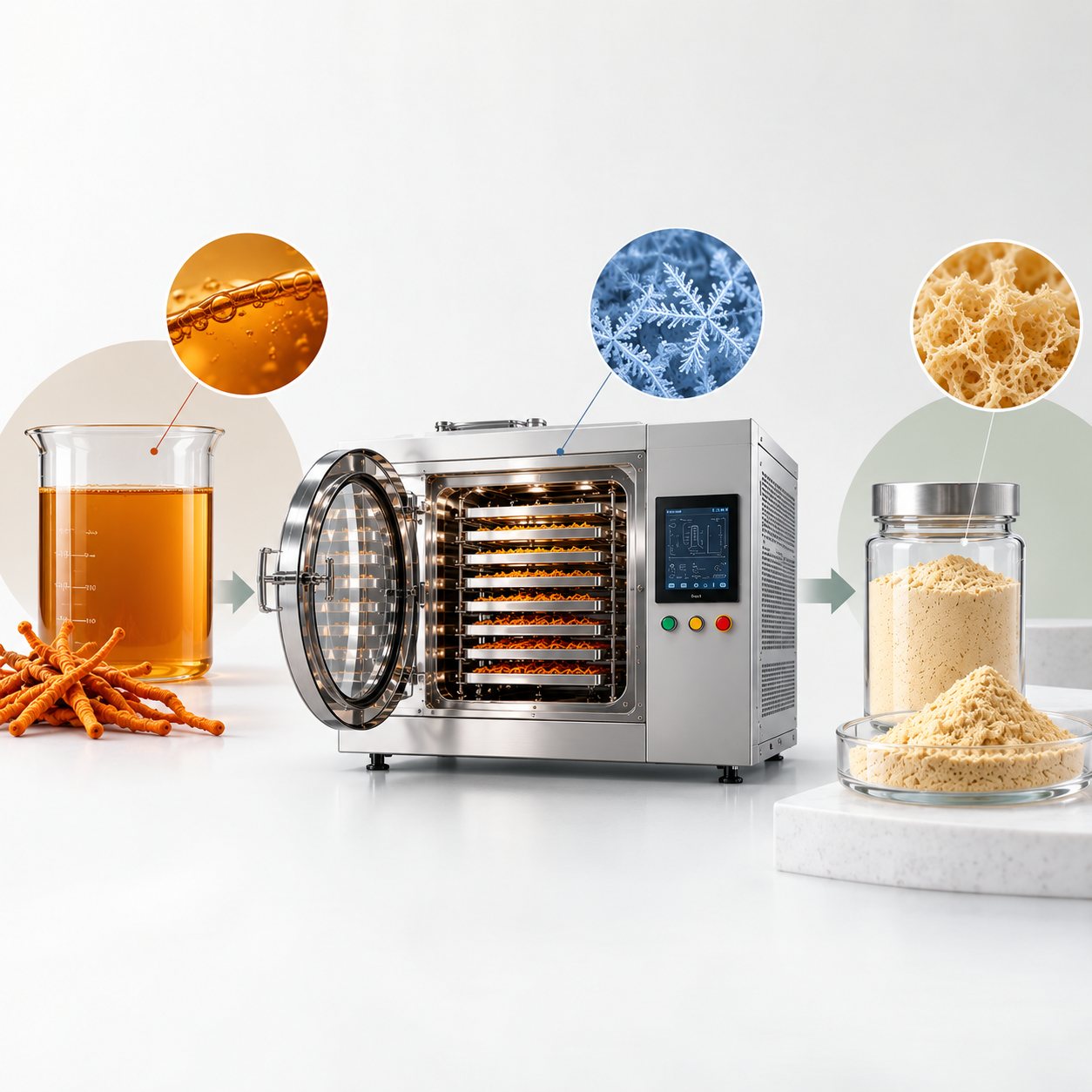
Lyophilization is drying by sublimation — a frozen material moves straight from solid to gas under vacuum, without passing through a liquid phase. It's a technology proven across biotechnology and pharmaceutical manufacturing for a reason: it holds product quality that other drying methods lose.
Biological agricultural products normally suffer from short shelf life, high production cost and reduced viability in transit. Lyophilization is what fixes that — the microbial culture survives the drying process instead of being damaged by it, which is what makes it possible to ship a live biological input across borders and have it still work when it arrives.
Three facilities, one standard.
Each facility runs its own R&D lab, fermentation and lyophilization systems, and quality-control testing suite — built to the same national and international standards, regardless of which one produces a given batch.
Kompally
Telangana IRA BIOTECHSy.No.639, Plot No: 8-117/A, Savalla Thanda, Devaryamjal, Tumkunta, Kompally, Medchal-Malkajgiri District, Hyderabad-500078, Telangana State.
R&D labs and quality-control units.
Charlapally
Telangana Plot No. 86, 87, 88, Navodaya Industrial Estate,IDA Cherlapally, Phase 5, Hyderabad 500051, Telangana.
Fermentation and lyophilization systems.
Sagar
Madhya PradeshPrimary production unit with modern laboratories and QC infrastructure.
Verified, not just claimed.
Aquaculture formulations additionally carry individual Coastal Aquaculture Authority (CAA) registration numbers, listed on their respective product pages.
Need a facility audit or spec sheet?
CIBRC/CAA registration documents and facility-level quality documentation are available on request.