IRA Biotech
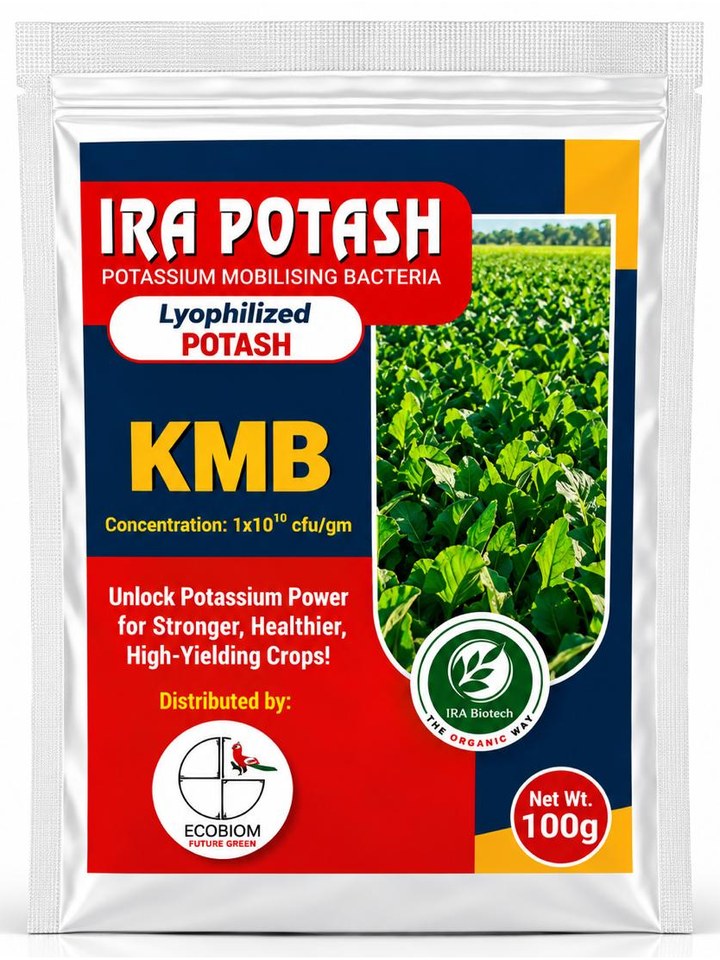
Potash is a microbial biofertilizer formulated with Bacillus mucilaginosus and Frateuria aurantia. The consortium helps mobilize and solubilize poorly available forms of potassium present in soil minerals, improving potassium availability to plants and supporting crop vigour, yield and quality.
Produced using lyophilization (freeze-drying) technology to enhance microbial viability, stability and shelf life.
Composition
| Parameter | Detail |
|---|---|
| Microorganisms | Bacillus mucilaginosus, Frateuria aurantia |
| Microbial count | 1 × 10¹⁰ CFU |
| Technology | Lyophilization (freeze-drying) |
Mode of Action
Beneficial potassium-mobilizing microorganisms establish in the soil and rhizosphere and produce organic acids and other metabolites that help release potassium bound within soil minerals. This biological activity increases potassium availability in the root zone and supports efficient plant uptake.
Key Benefits
- Helps mobilize soil potassium to the plant.
- Improves potassium availability and nutrient-use efficiency.
- Supports stronger roots and stems, and disease resistance.
- Enhances flowering, fruit development and yield quality.
- Improves drought tolerance and pest and disease resistance.
- Promotes beneficial rhizosphere microbial activity and soil fertility.
- Reduces dependency on conventional potassic fertilizers.
- Enhanced microbial stability through lyophilization technology.
Dosage and Application
Recommended dose: 1 litre per acre.
- Foliar application: dilute 1 litre in 150–200 litres of water per acre and spray uniformly over the crop.
- Drip / fertigation: apply 1 litre per acre through the drip or fertigation system with sufficient irrigation water for uniform distribution.
- Soil application: mix 1 litre with 50–100 kg of well-decomposed compost / FYM or a suitable organic carrier per acre, broadcast uniformly and follow with irrigation.
Recommended Crops
Cereals, pulses, vegetables, horticultural crops, fruit crops, plantations, commercial crops and pastures.
Compatibility
Compatible with most biological and organic agricultural inputs. Avoid direct mixing with bactericides, disinfectants or strongly antimicrobial products.
Storage
Store in a cool, dry place away from direct sunlight and excessive heat. Keep the container tightly closed.